Independent Work & Findings
Original case studies and technical findings, published independently of contracted work — every claim verified against a primary source.
Rubric-Level Defect — npj Digital Medicine
Identified a structural defect in the LLM-as-judge evaluation rubric of a paper published in npj Digital Medicine (9:349, 2026): one exclusionary clause left the evaluator blind to fabricated content while still catching omission. Verified directly against the authors' own supplementary figures. Disclosed privately to the corresponding author with a 14-day window; acknowledged, and publication invited.
Red-Flag Safety Gate for a PubMed-Grounded Evidence Tool
Clinical design of a narrow, pre-LLM red-flag gate for MedEvidence, a research and education evidence tool, after it missed preeclampsia: every citation was real, but it never searched for the one diagnosis that mattered. The design keeps passive triggers separate from the findings a clinician must confirm (to limit alert fatigue), treats "never assessed" differently from "deliberately not performed," and adds a plain CLINICAL BLINDSPOT warning instead of waiting on a pending lab. Credited by name as clinical designer in the founder's public write-up; the performance figures in that write-up are MedEvidence's own bench results.
Anti-NMDA-Receptor Encephalitis: Treating Under Diagnostic Uncertainty
A self-constructed, clearly labeled synthetic case (AI-assisted drafting, disclosed in the PDF). A multidisciplinary case study — Psychiatry → Medicine → Neurology — modeling how three services independently reason from an incomplete, partly conflicting record to the same empiric decision to treat, with every lab and imaging figure reconciled against the original source exhibits.
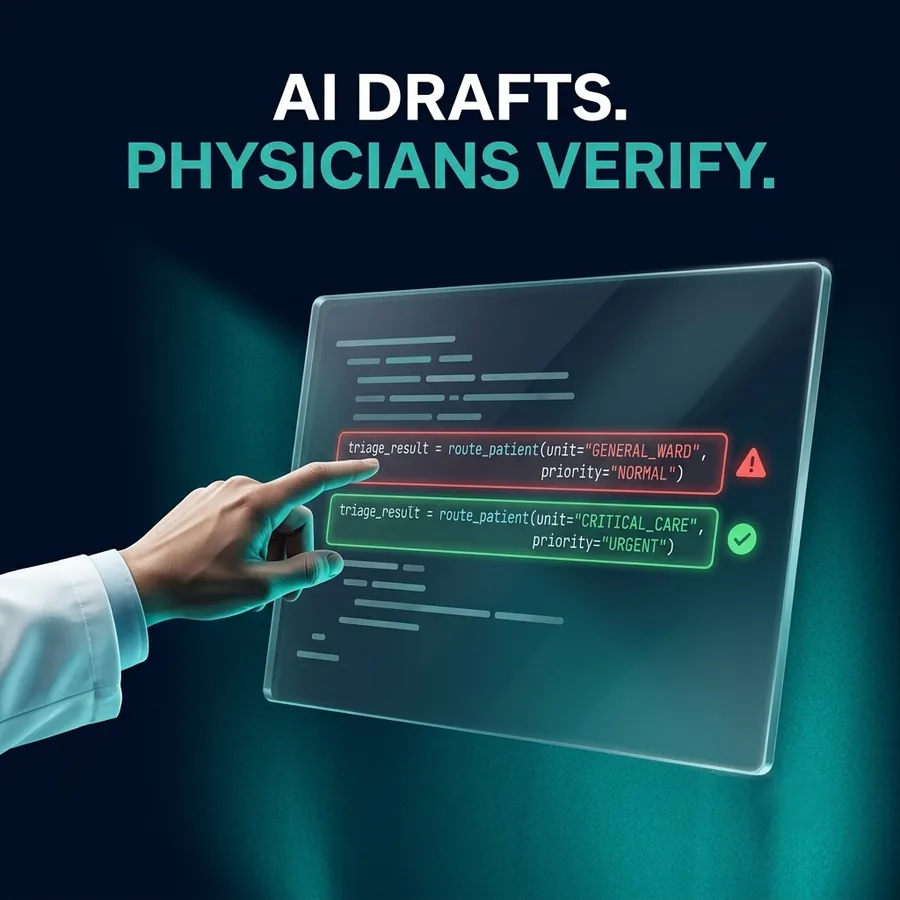 ▸ CLINICAL RULE-SET AUDIT
Physician-Verified Review of an AI-Generated Clinical Dataset
Clinical validation of a 72-rule code-derived rule set powering a synthetic Type 2 diabetes dataset used to train and benchmark medical AI models. A defined five-stage process — direct ICD-10-CM tabular lookup, clinical-correctness review, guideline verification, consequence analysis, severity triage — surfaced 35 defects spanning four independent failure layers: coding validity, clinical categorization, simulation logic, and care-pathway safety.